
Nonprofits don’t have a data problem. They have a data-entry problem.
Every community organization we’ve worked with does far more than it ever documents. The proof exists — on staff phones, in WeChat and text threads, in voice memos, sign-in sheets, forwarded emails, last year’s annual report. It’s just scattered, unlabelled, and forgotten by the time a grant report is due.
The tools built to fix this all start with the same demand: fill in this form, configure this database, run this survey. They ask the busiest people to structure information at the moment they’re least able to. So adoption fails and the database goes stale.
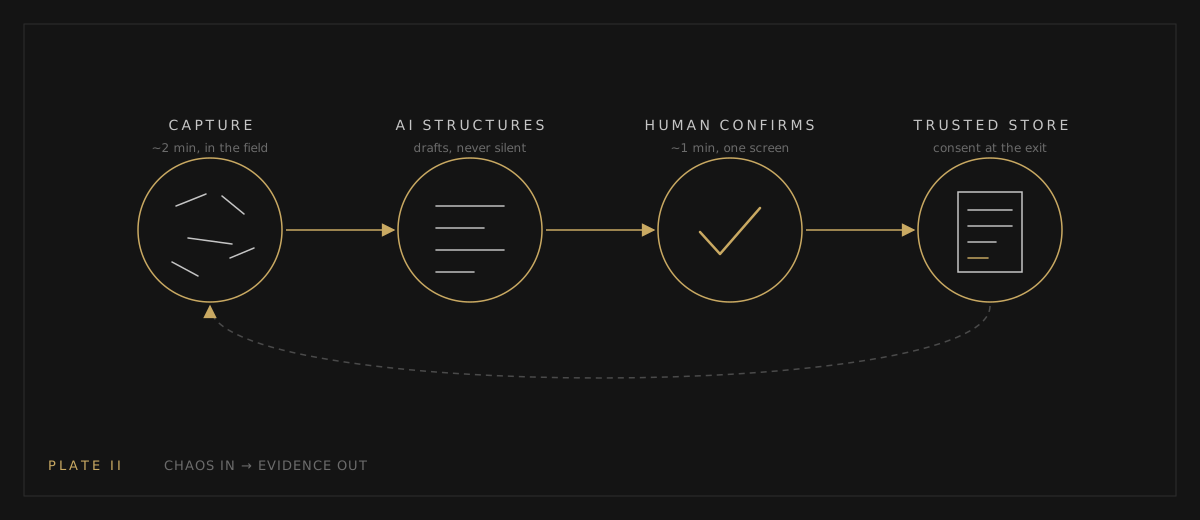
We built Evidence Core on the opposite premise: the system accepts chaos as input; structuring is the system’s job; humans only confirm.
How it works, in one loop:
- Capture — staff send what they already have (a photo, a 20-second voice note, an email, a text) from the tools already in their hands. About two minutes, in the field.
- AI structures — the system reads it in Chinese or English and proposes metrics, stories and links — as drafts. It never commits silently.
- Human confirms — a supervisor confirms, edits or discards on one screen and sets who may see it. About a minute.
- Trusted store — newsletters, monthly/annual reports and grant drafts are generated from confirmed, consent-cleared evidence, with every number traceable back to its source.
A few things we’re proudest of:
- Consent isn’t a policy — it’s architecture. Internal, funder and public scope is enforced at exactly two chokepoints, so a public newsletter physically cannot see non-public evidence.
- Bilingual by design, not by plugin.
- The data belongs to the organization: one-click full export, no lock-in.
- At roughly 1/10th the entry price of impact-measurement platforms, with the piece none of them have — capture.
It’s live today serving two organizations in the Chinese-American community, and we measure success behaviourally: staff capturing real activities without a developer in the room, and the AI correction rate falling week over week.
We’ve written a 3-page whitepaper for non-technical decision makers — concepts, a day-in-the-life scenario, how reports get generated, and an honest comparison with CRMs, impact platforms and DIY spreadsheets.
Evidence Core: Executive Whitepaper Whitepaper PDF Evidence Core whitepaper in Chinese Chinese whitepaper PDF
If you run a community nonprofit and your quarterly report still starts with “does anyone have photos from…?” — we’d love to talk. A pilot needs one program lead with a phone and one supervisor with ten minutes a week.
Start with one program
Tell us how your organization gathers its evidence today, and we’ll show you what an Evidence Core pilot would look like for your team.